The STAPEM Boreale is not just a DP2 vessel. It embodies the STAPEM Group integration strategy, combining in-house engineering, embedded subsea capabilities and coordinated marine execution to deliver IMR campaigns with reduced interfaces and controlled risk.
BUILT FOR VERSATILITY
Engineered, equipped and deployed as one.
The Challenge:Beyond the Asset
In offshore operations, complexity rarely comes from technology alone. It comes from interfaces. Operators often have to coordinate a vessel owner, an engineering firm for deck modifications, and a separate ROV contractor – each with its own scope, priorities and constraints. This fragmentation increases risk, slows mobilization and blurs responsibility. The challenge was clear: deliver a mission-ready asset where the vessel and the subsea system are not merely co-located, but genuinely integrated.
Powered by d2m Engineering
Integrated Design
Long before the Boreale reached the field, integration started at the design stage.
Our engineering teams performed the structural and naval studies required to permanently embed a work-class ROV capability into the vessel, ensuring safety, stability and operational efficiency from day one.
Key engineering contributions included:
Deck strengthening and structural reinforcements Design and verification of reinforcements to support the ROV Launch and Recovery System (LARS) under offshore operational loads.
System integration Integration of high-precision subsea positioning systems directly into the vessel, enabling accurate tracking and reliable subsea operations.
Stability and operational analysis Validation of vessel performance during crane operations and ROV deployment in challenging sea states.
This approach ensures that subsea capability is not an add-on, but a core function of the vessel.
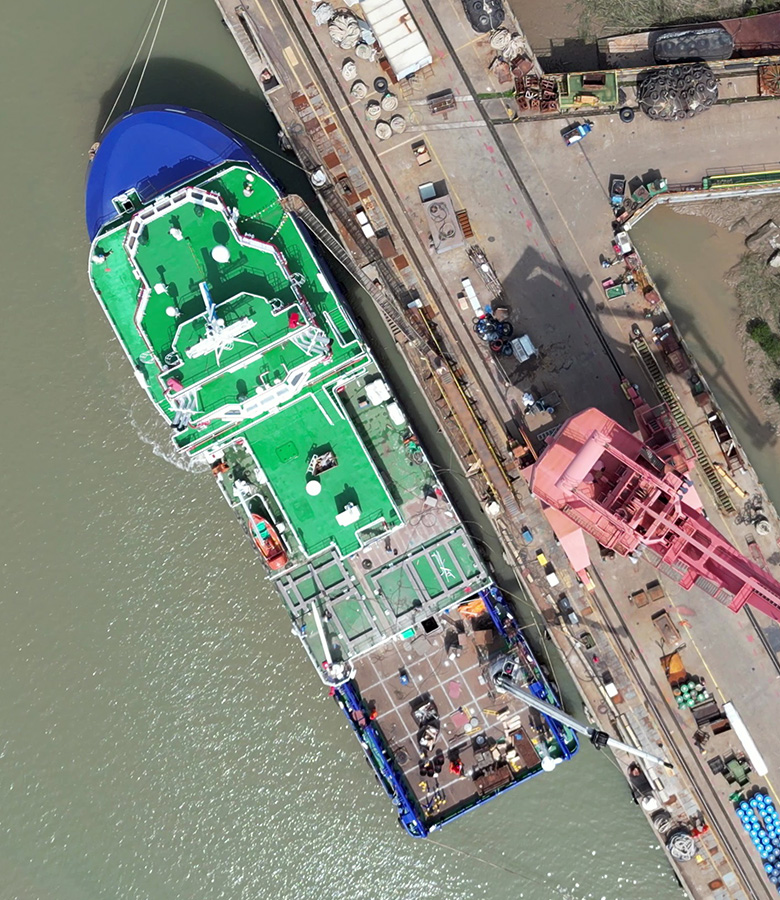
Topside view of the STAPEM Boreale during shipyard integration works, highlighting deck optimization for subsea system deployment.
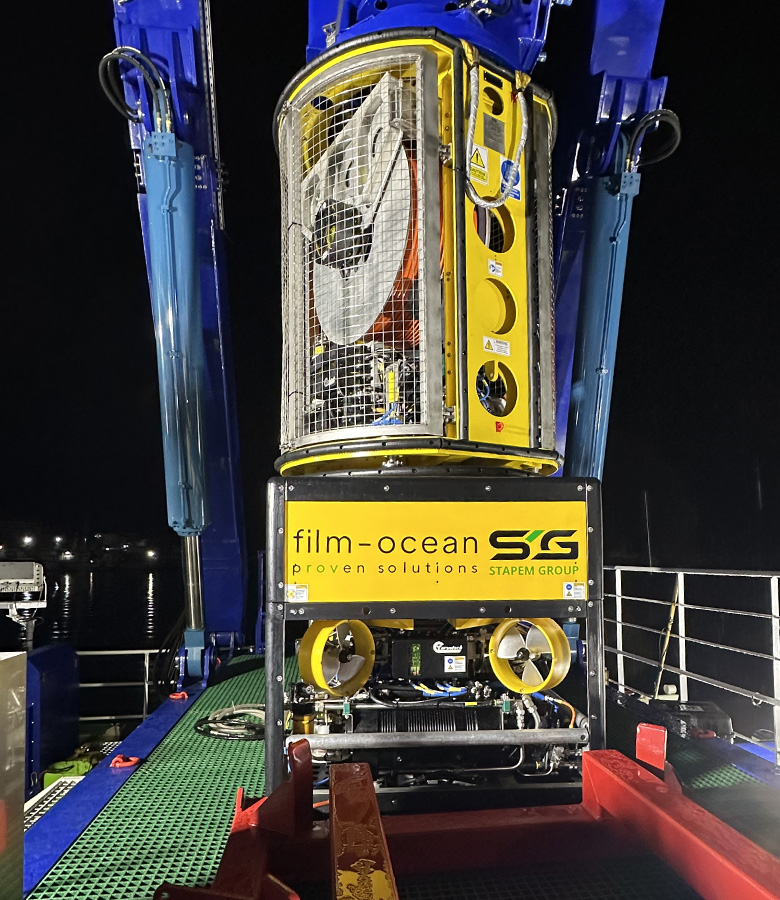
Work-class ROV mobilized on deck for subsea inspection and intervention activities.
Powered by Film-Ocean & STAPEM Offshore
Integrated Subsea Capability
The STAPEM Boreale is permanently equipped with a high-performance Atom work-class ROV and supported by STAPEM Offshore commercial diving teams.
Unlike third-party mobilizations that require dedicated setup time and complex interfaces, both the ROV and diving capabilities are fully embedded into the vessel’s operational workflow. They are ready to operate as soon as the vessel reaches the field.
This integrated subsea capability enables:
Deepwater inspection, survey and light intervention performed by work-class ROV without additional mobilization phases.
Commercial diving operations carried out by STAPEM Offshore divers for tasks where human dexterity, judgment and close visual inspection are required.
Unified command and execution, with ROV pilots, diving supervisors and vessel officers operating under a single operational structure.
Optimized operational windows, combining ROV and diving methods to maximize uptime and reduce weather-related inefficiencies.
The result is a hybrid subsea capability designed to select the safest and most efficient intervention method, operating as an integrated part of the vessel rather than as parallel services.
Powered by STAPEM Offshore
Integrated Marine Operations
Marine operations are designed as an integral part of the STAPEM Boreale operating model, ensuring full alignment between vessel behavior and subsea activities.
Through its Fleet Department, STAPEM Group defines operational interfaces, procedures and coordination mechanisms at project level, ensuring that marine execution supports subsea performance rather than constraining it.
This operating model is reinforced by STAPEM Offshore’s permanent presence in Luanda, Angola, with experienced local teams and an operational base located within the Sonils logistics hub.
This approach enables:
Operational control and interface management ensuring clear procedures, responsibilities and decision-making across marine and subsea workscopes.
Effective coordination between bridge teams, ROV pilots, diving supervisors and onshore support teams.
Operational continuity in Angola supported by local teams and direct access to port, logistics and marine services in Luanda.
Operational consistency across IMR campaigns, reducing execution risk for the client.
Marine operations are treated as a controlled execution layer within an integrated offshore system, coordinated by the STAPEM Group Fleet Department rather than delivered as an isolated service.
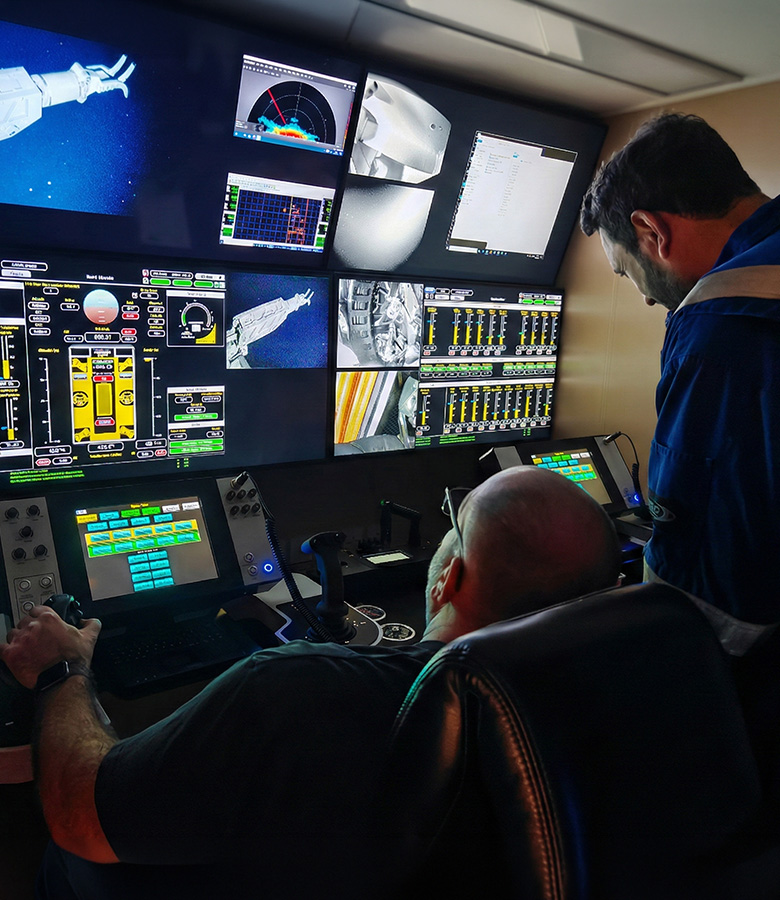
ROV control room onboard the STAPEM Boreale, where pilots and engineers monitor and control subsea operations in real time.